

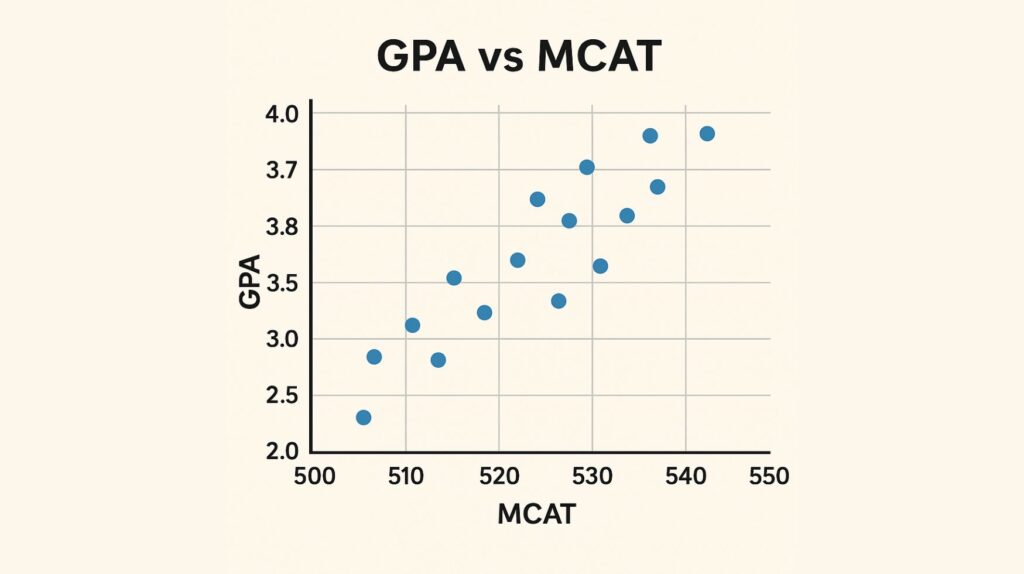
Breaking into medical school is one of the toughest challenges in higher education. With thousands of qualified students competing for limited seats, acceptance rates often stay below 10%. Among the many factors admissions committees review, two stand out above the rest: an applicant’s Grade Point Average (GPA) and their Medical College Admission Test (MCAT) score. This ongoing debate, GPA vs MCAT, is central to admissions, as both are vital indicators of academic strength and readiness for the demands of medical school. The pressing question remains: Which matters more, GPA or MCAT?
The answer is not straightforward. Admissions committees consider both factors within the broader context of the application, but their relative importance can vary depending on the school, the applicant’s overall profile, and the balance between these two key indicators. This article will dive deeply into the roles of GPA and MCAT scores, compare their weight in admissions, discuss how committees interpret them, and provide strategies for applicants to maximize their chances of success.
Understanding GPA in Medical School Admissions
What GPA Represents
Your GPA reflects long-term academic performance over several semesters or years of undergraduate education. Unlike the MCAT, which measures performance on a single standardized test day, GPA shows consistency, work ethic, and the ability to succeed across different courses, professors, and academic demands.
Medical schools often break GPA into three categories:
- Cumulative GPA: All coursework combined.
- Science GPA (BCPM: Biology, Chemistry, Physics, Math): Highlights performance in core pre-medical subjects.
- Non-science GPA: Other courses outside of the sciences.
The science GPA is often scrutinized most closely because it provides evidence of whether an applicant can handle medical school’s rigorous science-based curriculum.
Strengths of GPA
- Demonstrates long-term consistency rather than one-day performance.
- Provides insight into time management skills and ability to balance multiple commitments.
- Indicates persistence and growth (upward trends are valued even if the early GPA is lower).
Weaknesses of GPA
- GPAs can vary in meaning depending on the institution. A 3.8 at one university may not equal a 3.8 at another due to grade inflation or rigor differences.
- Less standardized compared to the MCAT, making it harder for admissions committees to compare applicants across diverse schools and majors.
Understanding the MCAT in Medical School Admissions
What the MCAT Represents
The MCAT is a standardized exam designed to test critical thinking, problem-solving, and scientific knowledge necessary for medical school success. It covers four major sections:
- Chemical and Physical Foundations of Biological Systems
- Critical Analysis and Reasoning Skills (CARS)
- Biological and Biochemical Foundations of Living Systems
- Psychological, Social, and Biological Foundations of Behavior
Scored on a scale of 472 to 528, with 500 as the median, the MCAT allows schools to compare applicants fairly, regardless of undergraduate institution.
Strengths of MCAT
- Standardized across all applicants, leveling the playing field between different universities.
- Predicts performance on the USMLE Step exams, a critical component of medical training.
- Provides a chance for students with weaker GPAs to demonstrate academic ability.
Weaknesses of MCAT
- Measures one-time performance, which can be affected by stress, illness, or test-day anxiety.
- Requires extensive preparation, often demanding months of study.
- Cannot fully measure long-term work ethic or resilience in the same way GPA does.
GPA vs. MCAT: How Admissions Committees Weigh Them
Admissions committees typically view GPA and MCAT scores as complementary measures rather than direct competitors. The GPA demonstrates sustained performance, while the MCAT confirms knowledge mastery and readiness for medical-level exams. Here are some key comparisons:
1. The Balance Between GPA and MCAT
- A strong GPA but weak MCAT may raise concerns about whether the student can perform well on standardized tests.
- A strong MCAT but weak GPA suggests that the applicant has raw academic ability but may struggle with consistency, time management, or coursework.
- Ideally, applicants want both metrics to be strong, but an imbalance can sometimes be compensated with other strengths in the application.
2. Minimum Cutoffs
Many schools use cutoffs to filter applications. For example:
- GPA cutoff: ~3.0
- MCAT cutoff: ~500
Applicants below these thresholds may not receive further consideration, regardless of other accomplishments.
3. Holistic Review
Most U.S. medical schools practice holistic admissions, considering GPA and MCAT alongside extracurriculars, clinical experience, research, volunteer work, and personal attributes. Still, GPA and MCAT often serve as the first hurdle before other parts of the application are reviewed.
Which Matters More?
The debate about GPA vs. MCAT importance has no universal answer, but patterns emerge when analyzing admissions data.
Data Insights
According to the AAMC (Association of American Medical Colleges):
- Applicants with GPA above 3.8 and MCAT scores above 510 have the highest acceptance rates (over 80%).
- Applicants with low GPA but high MCAT (e.g., 3.0 GPA, 520 MCAT) face challenges because GPA reflects day-to-day performance in coursework.
- Conversely, applicants with high GPA but low MCAT may struggle to prove standardized exam readiness.
General Rule
- MCAT is slightly more influential because it standardizes applicants across diverse backgrounds. A stellar MCAT can open doors for students with an average GPA, while an excellent GPA may not always compensate for a weak MCAT.
- However, both are essential, and a deficiency in one usually requires an outstanding performance in the other to remain competitive.
Contextual Factors That Affect Importance
1. Type of Medical School
- MD Programs (Allopathic): Often emphasize MCAT more strongly due to competition and the need for standardized comparisons.
- DO Programs (Osteopathic): Tend to be slightly more forgiving of lower MCAT scores if GPA and holistic attributes are strong.
2. Applicant Background
- Non-traditional applicants (career changers, post-bacc students) may rely more on the MCAT to demonstrate current readiness.
- Students from rigorous universities may find their GPA given more weight when admissions committees recognize the difficulty of coursework.
3. Upward Trends
Applicants with a lower cumulative GPA but strong improvement over time may still be competitive, especially when paired with a solid MCAT.
Strategies for Applicants
If Your GPA Is Strong but MCAT Is Weak
- Invest in a comprehensive MCAT study plan (commercial prep courses, tutoring, or self-study programs).
- Consider delaying your application until you achieve a competitive score.
- Use personal statements and recommendation letters to highlight consistency, dedication, and clinical experiences.
If Your MCAT Is Strong but GPA Is Weak
- Consider enrolling in a post-baccalaureate or master’s program to demonstrate academic improvement.
- Emphasize your MCAT score as evidence of academic potential.
- Explain any extenuating circumstances for GPA dips (illness, personal challenges) in secondary applications.
If Both Are Weak
- Gain additional academic credentials (e.g., special master’s programs).
- Strengthen other parts of the application (clinical work, research, volunteering).
- Consider applying to DO schools or international medical programs where holistic review may provide more flexibility.
Beyond Numbers: The Bigger Picture
Although GPA and MCAT are critical, they are not the sole determinants of admission. Committees also value:
- Clinical experience (shadowing, volunteering, patient interaction).
- Research experience, especially at academic medical centers.
- Leadership and service, such as community outreach or campus involvement.
- Personal statements and interviews, which reflect motivation, communication skills, and empathy.
Strong applicants often view GPA and MCAT as foundational metrics, but they ensure that the rest of their application tells a compelling story of passion, resilience, and commitment to medicine.
Conclusion
So, which matters more: GPA or MCAT? The truth is, both matter greatly, but the MCAT often carries slightly more weight because of its standardized nature. A strong MCAT score can help overcome a weaker GPA more effectively than the reverse, but GPA remains crucial for demonstrating consistent academic success. Ultimately, the most competitive applicants excel in both areas while also building a well-rounded profile that reflects readiness for the challenges of medical school.
For students preparing to apply, the key is not to pit GPA against MCAT but to recognize how they complement each other. By understanding their roles, applicants can strategically strengthen their academic record, test performance, and overall candidacy, maximizing their chances of joining the next generation of physicians.