

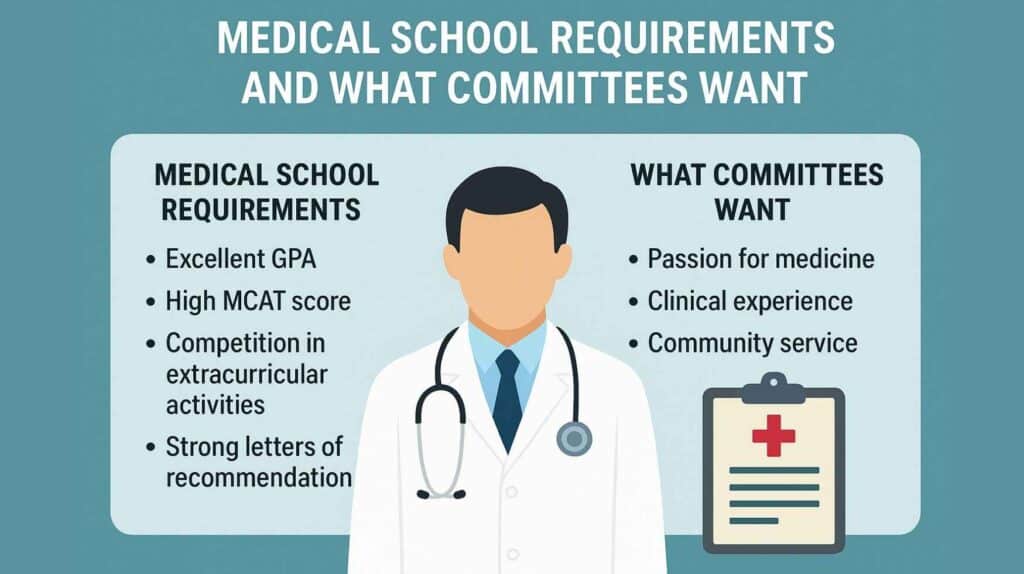
Getting into medical school is one of the biggest dreams for many students. Becoming a doctor means years of hard work, but it also comes with respect, the ability to help people, and a rewarding career. Because of this, medical schools are very selective. Thousands of students apply every year, but only a small percentage are accepted.
If you want to apply to medical school, you need to understand two things:
- The basic Medical School Requirements every applicant must meet.
- The qualities admissions committees look for beyond the basics.
This blog will explain both in detail, in easy English, so you can prepare the best application possible.
1. Academic Requirements
Medical schools want to make sure you can handle the difficult science-based curriculum. For this reason, your grades and test scores matter.
GPA (Grade Point Average)
- Most medical schools expect a strong GPA, usually 3.5 or higher.
- Both science and non-science courses are important, but biology, chemistry, physics, and math (the “BCPM” subjects) carry extra weight.
- A lower GPA does not automatically mean rejection, but you will need to show strength in other areas (like research, MCAT, or unique experiences).
MCAT (Medical College Admission Test)
- The MCAT is a standardized exam required by almost all U.S. medical schools.
- It tests your knowledge of biology, chemistry, physics, psychology, sociology, and critical thinking.
- A competitive score is usually 510 or higher (out of 528).
- Strong performance can balance a slightly lower GPA.
Coursework
Most Medical School Requirements include specific classes before applying:
- 1 year of biology with lab
- 1 year of general chemistry with lab
- 1 year of organic chemistry with lab
- 1 year of physics with lab
- 1 year of English or writing
- 1 semester of biochemistry (increasingly required)
- Math (calculus or statistics, depending on the school)
These requirements ensure that you have the science foundation needed for medical school.
2. Clinical Experience
Medical schools want proof that you understand what being a doctor really means. This is where clinical experience comes in.
Examples of clinical experience:
- Shadowing a doctor: Observing how physicians work with patients.
- Volunteering in a hospital or clinic: Helping patients, staff, or families.
- Working as a medical assistant, EMT, scribe, or nurse aide.
Admissions committees look for consistency. A few hours of shadowing is not enough, you should aim for at least 100–200 hours of direct exposure.
Why it matters:
- Shows you are serious about medicine.
- Helps you decide if medicine is the right path for you.
- Gives you real stories to use in your essays and interviews.
3. Research Experience
Not every applicant has research experience, but many successful students do. Medical schools value it because research teaches you critical thinking and problem-solving.
- Lab research: Working in biology, chemistry, or medical labs.
- Clinical research: Collecting patient data or working with clinical trials.
- Public health research: Studying health trends in communities.
Some schools, especially research-focused ones like Harvard or Johns Hopkins, place a high value on research. Others focus more on clinical work.
4. Community Service and Volunteering
Medicine is about helping others. Committees want to see that you have a service mindset.
Examples:
- Volunteering at homeless shelters or food banks.
- Tutoring children in underserved communities.
- Helping with health fairs or vaccination drives.
The key is long-term involvement. A few hours here and there do not stand out. Consistent service over months or years shows commitment and compassion.
5. Leadership and Extracurriculars
Doctors are leaders in healthcare teams. Medical schools want to see that you can take initiative and guide others.
Examples of leadership:
- Leading a student organization.
- Coaching a sports team.
- Organizing community events.
- Serving as a teaching assistant.
Extracurricular activities outside of science also matter. Playing an instrument, sports, or writing for the school newspaper shows you are a well-rounded person.
6. Strong Letters of Recommendation
Letters of recommendation give committees an outside perspective on who you are. Most schools ask for 3–4 letters:
- 2 from science professors.
- 1 from a non-science professor or mentor.
- 1 from a doctor or research supervisor (optional, but helpful).
What committees want from these letters:
- Proof of your academic ability.
- Insight into your character, work ethic, and teamwork.
- Examples of leadership and compassion.
Choose recommenders who know you well, not just professors who gave you good grades.
7. Personal Statement
Your personal statement is your chance to tell your story. It should answer:
- Why do you want to be a doctor?
- What experiences shaped this goal?
- What qualities make you a good fit for medicine?
Committees read thousands of essays, so yours should be:
- Authentic: Be honest and personal.
- Specific: Share real experiences, not vague statements.
- Reflective: Show what you learned, not just what you did.
This essay is one of the most important Medical School Requirements, because it helps committees understand your motivation. If you struggle to express your story clearly, using Medical School Personal Statement Editing services can help refine your message and make your essay stand out.
8. Secondary Essays
After the primary application, most schools send secondary essays with their own questions. Common topics include:
- Why do you want to attend this school?
- How do you contribute to diversity in medicine?
- Describe a time you faced a challenge.
These essays show how much effort you are willing to put in. Quick, generic answers hurt your chances.
9. The Interview
If you make it to the interview stage, committees already think you are academically qualified. Now they want to know:
- Do you have the right personality for medicine?
- Are you empathetic, professional, and a good communicator?
- Can you handle stress and pressure?
Types of interviews:
- Traditional interview: One-on-one conversation.
- Panel interview: Multiple interviewers asking questions.
- MMI (Multiple Mini Interviews): Short stations with scenarios or ethical questions.
To succeed:
- Be confident, but not arrogant.
- Practice explaining why you want to be a doctor.
- Show emotional intelligence and compassion.
Interviews are not just another box to check, they are one of the most important Medical School Requirements for acceptance.
10. What Committees Truly Want
Now that we’ve covered the formal requirements, let’s look at the bigger picture. Committees are not just looking for “perfect” students with a 4.0 GPA and a 520 MCAT. They want future doctors who are:
- Smart enough to handle medical school academics.
- Compassionate toward patients.
- Dedicated and able to handle long hours.
- Resilient when facing challenges.
- Team players who can work with nurses, other doctors, and staff.
- Ethical and trustworthy.
In other words, meeting the Medical School Requirements is only part of the journey. Showing your human side is just as important.
11. Common Mistakes to Avoid
Many students hurt their applications by making avoidable mistakes:
- Focusing only on grades and forgetting clinical experience.
- Writing a generic personal statement.
- Waiting too late to apply (rolling admissions means earlier is better).
- Not preparing for interviews.
- Choosing recommendation writers who barely know them.
Avoiding these mistakes can make a big difference.
12. Final Tips for Applicants
- Start early. Preparing takes years, not months.
- Balance your application. Don’t rely only on academics.
- Be consistent. Long-term activities look better than short-term ones.
- Show reflection. Explain what you learned from experiences.
- Stay motivated. The process is tough, but persistence pays off.
Conclusion
Medical school admissions are tough, but not impossible. If you understand the Medical School Requirements and show the qualities committees value, you can stand out. Remember: they are not just looking for smart students, they are looking for future doctors who care about people, can handle challenges, and want to make a difference.
By focusing on strong academics, clinical exposure, community service, leadership, and personal growth, you can build a powerful application. Your journey will not be easy, but with preparation, resilience, and genuine passion, you can meet the Medical School Requirements and move one step closer to becoming a doctor.